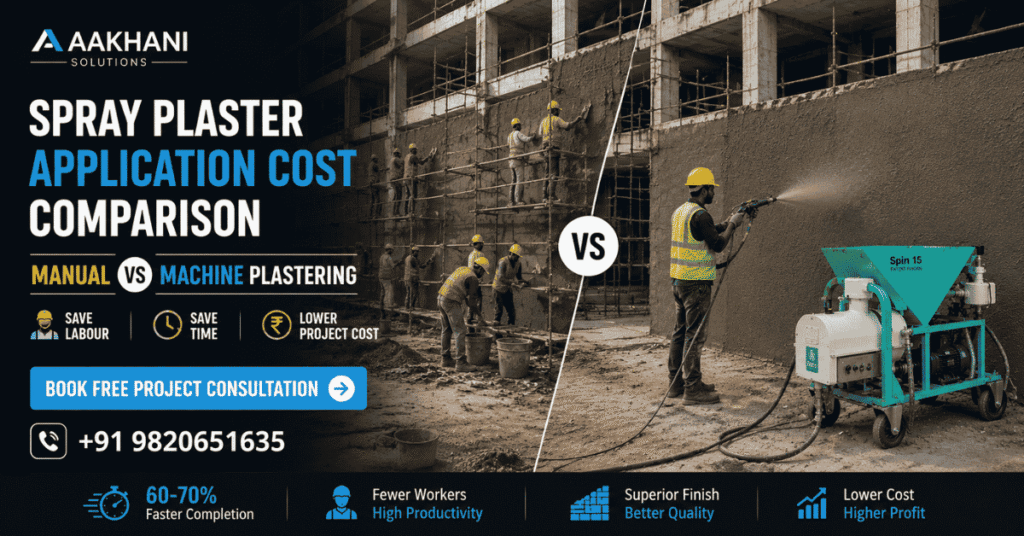
Spray Plaster Application Cost Comparison: Real Numbers
Spray Plaster Application Cost is one of the most labour-heavy stages of any build. On a typical Indian site, the process hasn’t changed in decades. sand and cement or a bag of ready-mix plaster is carried to the work area, mixed by hand or in a small mixer, ferried to the wall, and applied by a mason, one trowel-load at a time. A cement plaster spray machine changes that sequence entirely, mixing, conveying and spraying the material onto the wall in one continuous pass.
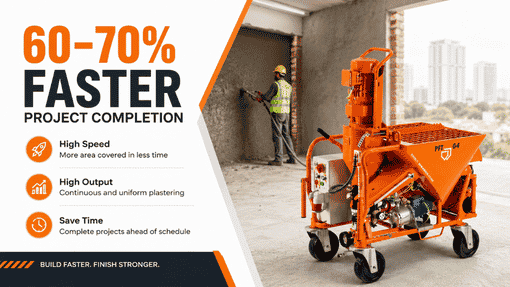
Contractors who switch report cutting day-to-day plastering time by 60–70%. With skilled mason availability tightening in most Indian cities and labour costs climbing every year, that 60–70% time saving isn’t just a convenience — it’s becoming one of the few practical levers contractors have to keep plastering schedules and budgets under control on larger projects.
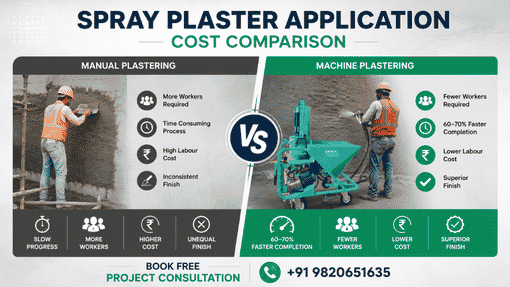
The Conventional Way: Three Steps, Three Handoffs
Most plastering on Indian sites still happens like this: sand (typically graded 2mm down) and cement, or bags of ready-mix plaster, are brought to the application point. The material is mixed with water in a plaster tray or pan by hand, or in a small drum mixer, to a workable consistency. The mixed plaster is then transported to the mason, who applies it to the wall by hand.
Every one of those steps adds time, depends on manual labour, and introduces inconsistency. Water dosing, mix uniformity, and application thickness all vary from mason to mason.
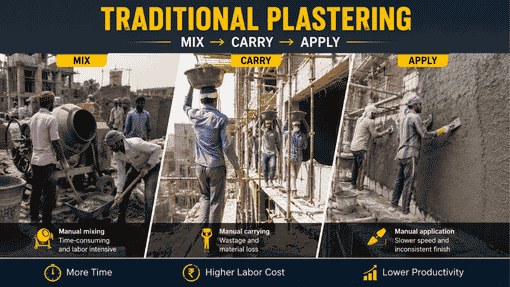
Mix. Convey. Spray. One Machine, One Pass.
A plaster spray machine collapses all three steps into one continuous operation. It mixes the plaster with water, conveys it through a hose under pressure, and sprays it directly onto the wall. With one operator at the gun instead of a full mixing-and-carrying crew.
On a machine like the IMER Koine 4, bagged plaster is fed into a hopper, where a feed wheel continuously doses it into a mixing chamber along with a controlled amount of water. The mixed material is then pulled in by a rotor-stator pump and pushed through the delivery hose to the gun. At the gun, compressed air atomises the material and applies it to the wall from roughly 20cm away, with the flow started and stopped right at the gun. One pass, no relay of buckets, no separate mixing crew.
One machine, one pass: mix → convey at 30 bar → spray from 20cm. No separate crew, no bucket relay.
Why You Cannot Just Spray Ordinary Plaster or Standard Ready Mix Plaster
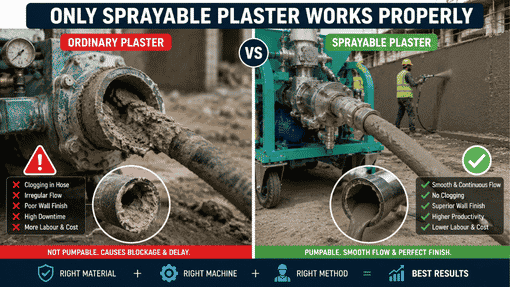
This is the part most people miss. Not every plaster — not even every ready mix plaster — can go through a spray machine. The rotor-stator pump that conveys the material to the gun builds up a pressure of around 30 bar. Ordinary sand-cement plaster, and most standard ready mix plaster formulated for trowel application, simply doesn’t have the bond strength between sand and cement to hold together under that pressure — it segregates, clogs the hose, or fails to flow consistently.
A sprayable formulation needs the right polymer dosage engineered together with correctly graded sand (2mm down) and cement, so the mix stays cohesive and pumpable at pressure. This isn’t something you mix on site — it’s a pre-formulated, factory-bagged product. The contractor’s job is simply to feed the bag into the machine; the material itself is engineered to survive the pump.
What Is Spray Plaster Application Cost in India: Real Numbers for a 9,600 sq ft Job
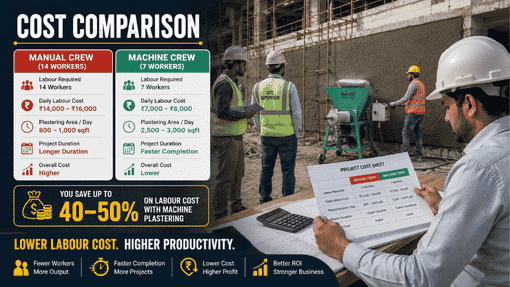
Numbers make the case better than percentages alone. Here is a real cost comparison for external plastering (2-coat average, including site preparation and material shifting) on a 9,600 sq ft job — manual crew versus a machine-applied crew:
| Cost Comparison | Manual Application | Machine Application |
|---|---|---|
| Crew | 8 masons + 6 helpers | 5 masons + 2 helpers |
| Daily wage rate | ₹1,000/mason, ₹700/helper | ₹1,500/mason, ₹1,000/helper |
| Wages per day | ₹12,200 | ₹9,500 |
| Monthly wage outpay | ₹3,66,000 | ₹2,85,000 |
| Output (external, 2 coats avg.) | 9,600 sq ft | 9,600 sq ft |
| Labour cost per sq ft | ₹38.1 | ₹29.7 |
| Rotor-stator wear & tear | — | ₹5.2/sq ft |
| Machine maintenance | — | ₹0.5/sq ft |
| All-in cost per sq ft | ₹38.1 | ₹35.4 |
A few things stand out. First, the labour bill itself drops by ₹81,000 a month (₹3,66,000 to ₹2,85,000) for the same 9,600 sq ft of work as the crew shrinks from 14 people to 7. The machine absorbs the mixing and conveying work that used to need extra hands.
Second, even after loading the machine’s own running costs — rotor-stator wear and routine maintenance, together about ₹5.7/sq ft — the all-in cost still comes out lower: ₹35.4/sq ft versus ₹38.1/sq ft for manual application, a saving of roughly ₹2.7/sq ft (about 7%).
Third, if you also amortise the machine itself as a capital asset — typically ₹2–3/sq ft. Depending on how heavily it’s utilised, the all-in machine cost moves to roughly ₹37.4–38.4/sq ft, putting it at or near parity with manual application on raw cost alone. The financial case for a spray machine isn’t that it’s dramatically cheaper per square foot. It’s that the same (or slightly better) cost buys you the job done with half the crew and in a fraction of the time. Freeing up masons and helpers, and site days, for the next project.
Benefits of Switching to a Spray Plaster Machine
Saves 60–70% of daily operational time and effort – mixing, conveying, and spraying happen in one pass instead of three separate manual steps.
Negligible human intervention — one operator runs the machine and gun; there’s no mixing crew or bucket-relay needed.
Consistent application quality – water dosing and mix consistency are controlled by the machine, not by how the mason mixed that particular batch.
Is It Worth It?
For any contractor or developer plastering at scale, the math is straightforward. Less labour dependency, faster turnaround per site, and a more consistent finish. The trade-off is that it only works with plaster designed to be pumped, which means sourcing the right polymer-modified, sprayable mix alongside the machine, not just buying the equipment on its own.
It’s worth sizing the decision to the project rather than treating it as all-or-nothing. A single high-rise tower, a multi-building residential project, or a contractor running several sites in parallel will recover the equipment cost far faster than a one-off small job. Simply because the time saved multiplies with every wall sprayed instead of trowelled. For smaller or one-time jobs, hiring a machine with an operator. A service several plaster manufacturers and dealers now offer alongside their sprayable, ready-mix plaster. Can deliver the same time and quality benefits without the upfront equipment investment.
Ready to Cut Plastering Time by 60–70%?
Connect with an Aakhani plaster expert. Share your project area, location, and start date — and get a cost model built around your site, not a generic estimate. Schedule a Call: Manual vs Aakhani Spray
Frequently Asked Questions
No. The rotor-stator pump builds up pressure of around 30 bar. Ordinary sand-cement plaster, and most standard ready mix plaster formulated for trowel application, simply doesn’t have the bond strength between sand and cement to hold together under that pressure — it segregates, clogs the hose, or fails to flow consistently. A sprayable formulation needs the right polymer dosage engineered together with correctly graded sand (2mm down) and cement.
Based on the Aakhani cost model for Indian market rates as of 2026, machine application comes to ₹35.4/sq ft all-in (including rotor-stator wear at ₹5.2/sq ft and maintenance at ₹0.5/sq ft) versus ₹38.1/sq ft for a manual crew on a 9,600 sq ft external plastering job. If you also amortise the machine as a capital asset, typically ₹2–3/sq ft, the all-in cost moves to roughly ₹37.4–38.4/sq ft — at or near parity with manual application.
For the same 9,600 sq ft of work, the crew shrinks from 14 people (8 masons + 6 helpers) to 7 people (5 masons + 2 helpers). The monthly wage outpay drops from ₹3,66,000 to ₹2,85,000 — a saving of ₹81,000 a month. Daily operational time savings are reported at 60–70% because mixing, conveying, and spraying happen in one pass instead of three separate manual steps.